https://www.youtube.com/watch?v=v-hIVnmUdXM&t=630s

watching  Jordan Peterson and Camille Paglia on a youtube vid discussing postmodernism and relativism and academic discourse.  Only into the first few minutes but thought this from JP was interesting:  he makes the analogy of the weakness of an animal that is marked in some way – marked out as different from the herd – eg when observers marked an animal so that they could follow its progress in the herd.  this animal became much easier for the lion to catch, Jp makes the point that the vulnerability of the animal was not because of age or weakness but was because it was marked as different.

JP uses this analogy to explain the consensus of academic opinion – opinion that he disagrees with and sees as untenable.  is that academics have safety in group thinking. CP appreciates this.  They do not seem to note that they are creating their own consensus


Not sure about JP or CP –  they both are emotionally wound up in their beliefs.

https://www.theguardian.com/stage/2018/jan/04/dave-chappelle-comedy-standup-transgender-netflix

Dave Chappelle’s ‘reckless’ #MeToo and trans jokes have real after-effects

He then makes another, more familiar claim, which is that it’s not a comedian’s job to be right, but to be reckless. Addressing other comics, he tells them: “You have a responsibility to speak recklessly, otherwise my kids might not know what reckless talk sounds like. The joys of being wrong. I didn’t come here to be right, I just came here to fuck around.” In the other gig, he claims that, “as a policy, you gotta understand, I never feel bad about anything I say up here”

That’s the standard comics’ defence: first, I’m only joking, and second, a comedy stage must be a space (one of few remaining) where prevailing standards of correctness don’t apply. It’s a persuasive argument. We live in censorious times; people can be quick to take offence and over-eager to silence opposing voices. I do believe that comedy, and art in general, needs a leeway not always afforded elsewhere in the public sphere. As it wrangles with reality and tries to see things in new ways, it needs to be able to risk being wrong, or indeed hurtful.

Sometimes recklessness can be a comic virtue, too. But I’m not convinced Chappelle is being reckless when he dedicates substantial parts of consecutive standup sets to jokes about trans people. These are deliberate choices, made by a comic who clearly weighs his every word. Nor am I convinced that Chappelle’s children are in any danger of not knowing what reckless speech sounds like. Are they not on Twitter? Do they never hear their president speak? Reckless speech is everywhere – the only difference is, these days, it’s no longer given a free pass.

But I take Chappelle’s central point, that comedy has to defend its right to go against the grain, to test the boundaries of the sayable. In The Bird Revelation, he addresses #MeToo: the allegations against Harvey Weinstein, Kevin Spacey and Chappelle’s fellow comedian Louis CK. It’s an extended routine, staking out the perspective of a sympathetic alpha male and “imperfect ally”. While the protests against his jokes about CK’s and Spacey’s alleged victims will drown it out, there’s some thoughtful material here that reaches beyond the black-and-white verities of the post-Weinstein moment.

And yet those protests are justified. Several of the jokes punch down; others rehash the idea that victims of sexual harassment should “man up”. These aren’t the boundaries of the sayable: this is what reactionaries say every day. As in his earlier Netflix specials, here again he contrasts 21st-century social justice struggles with anti-racism, and finds them “weak” by comparison.

Now, I have no quibble with Chappelle saying this stuff on stage. I don’t think he should be silenced. But his right to recklessness is equal only to the right of others to criticise, debate and get “really mad” at him. You can claim the standup stage as a protected (safe?) space to speak without fear of censure. You can ask your listeners to remember that you’re just trying to be funny. But you can’t pretend that comedy, reckless or otherwise, doesn’t have after-effects in the real world. It does: it can reinforce (or challenge) how people think. It gets repeated in the playground, and the workplace. It isn’t consequence-free.

I support Chappelle’s right to be speak freely, but it comes with responsibilities – not least to respect the right of others to speak freely right back at him.

Savvy painter episode Expanding Your Painting Skills, the Drawback of Viewing Art Digitally and more with Claudia Rilling

A spot on discussion about the lack of a shared language and a shared set of concepts about art which gives rise to an inability for an artist to talk to some people about what they do.

What is the source of this gap between what the artist knows and deals with and what the ‘non artist? layperson? – what is the best way of expressing it? person knows and deals with –

are there other areas of experience which also have this gap

what are the implications – social/political etcetera of this – after all its part of the economy/public money/state universities/schools etcetera?

http://www.bbc.com/future/story/20180116-the-mystery-of-why-some-people-become-sudden-geniuses

There’s mounting evidence that brain damage has the power to unlock extraordinary creative talents. What can this teach us about how geniuses are made?

It was the summer of 1860 and Eadweard Muybridge was running low on books. This was somewhat problematic, since he was a bookseller. He handed his San Francisco shop over to his brother and set off on a stagecoach to buy supplies. Little did he know, he was about to change the world forever.

He was some way into his journey, in north-eastern Texas, when the coach ran into trouble. The driver cracked his whip and the horses broke into a run, leading the coach surging down a steep mountain road. Eventually it veered off and into a tree. Muybridge was catapulted into the air and cracked his head on a boulder.

He woke up nine days later at a hospital 150 miles (241 km) away. The accident left him with a panoply of medical problems, including double vision, bouts of seizures and no sense of smell, hearing or taste. But the most radical change was his personality.

Previously Muybridge had been a genial and open man, with good business sense. Afterwards he was risk-taking, eccentric and moody; he later murdered his wife’s lover. He was also, quite possibly, a genius.

The question of where creative insights come from – and how to get more of them – has remained a subject of great speculation for thousands of years. According to scientists, they can be driven by anything from fatigue to boredom. The prodigies themselves have other, even less convincing ideas. Plato said that they were the result of divine madness. Or do they, as Freud believed, arise from the sublimation of sexual desires? Tchaikovsky maintained that eureka moments are born out of cool headwork and technical knowledge.

But until recently, most sensible people agreed on one thing: creativity begins in the pink, wobbly mass inside our skulls. It surely goes without saying that striking the brain, impaling it, electrocuting it, shooting it, slicing bits out of it or depriving it of oxygen would lead to the swift death of any great visions possessed by its owner.

19th Century stagecoach (Credit: Alamy)

Eadweard Muybridge was thrown from a stagecoach – and then led a life of creative genius (Credit: Alamy)

As it happens, sometimes the opposite is true.

After the accident, Muybridge eventually recovered enough to sail to England. There his creativity really took hold. He abandoned bookselling and became a photographer, one of the most famous in the world. He was also a prolific inventor. Before the accident, he hadn’t filed a single patent. In the following two decades, he applied for at least 10.

In 1877 he took a bet that allowed him to combine invention and photography. Legend has it that his friend, a wealthy railroad tycoon called Leland Stanford, was convinced that horses could fly. Or, more accurately, he was convinced that when they run, all their legs leave the ground at the same time. Muybridge said they didn’t.

To prove it he placed 12 cameras along a horse track and installed a tripwire that would set them off automatically as Stanford’s favourite racing horse, Occident, ran. Next he invented the inelegantly named “zoopraxiscope”, a device which allowed him to project several images in quick succession and give the impression of motion. To his amazement, the horse was briefly suspended, mid-gallop. Muybridge had filmed the first movie – and with it proven that yes, horses can fly.

Jon Sarkin was transformed from a chiropractor into an artist after a stroke

The abrupt turnaround of Muybridge’s life, from ordinary bookseller to creative genius, has prompted speculation that it was a direct result of his accident. It’s possible that he had “sudden savant syndrome”, in which exceptional abilities emerge after a brain injury or disease. It’s extremely rare, with just 25 verified cases on the planet.

There’s Tony Cicoria, an orthopaedic surgeon who was struck by lightning at a New York park in 1994. It went straight through his head and left him with an irresistible desire to play the piano. To begin with he was playing other people’s music, but soon he started writing down the melodies that were constantly running through his head. Today he’s a pianist and composer, as well as a practicing surgeon.

Another case is Jon Sarkin, who was transformed from a chiropractor into an artist after a stroke. The urge to draw landed almost immediately. He was having “all kinds” of therapy at the hospital – speech therapy, art therapy, physical therapy, occupational therapy, mental therapy – “And they stuck a crayon in my hand and said ‘want to draw?’ And I said ‘fine’,” he says.

Cat picture by Gottfried Mind (Credit: Alamy)

Gottfried Mind was an “artistic savant” who drew cats in extraordinary detail (Credit: Alamy)

His first muse was a cactus at his home in Gloucester, Massachusetts. It was the fingered kind, like you might find in Western movies from the 50s. Even his earliest paintings are extremely abstract. In some versions the branches resemble swirling green snakes, while others they are red, zig-zagging staircases.

His works have since been published in The New York Times, featured on album covers and been covered in a book by a Pulitzer Prize-winning author. They regularly sell for $10,000 (£7,400).

Most strikingly there’s Jason Padgett, who was attacked at a bar in Tacoma, Washington in 2002. Before the attack, Padgett was a college dropout who worked at a futon store. His primary passions in life were partying and chasing girls. He had no interest in maths – at school, he didn’t even get into algebra class.

But that night, everything changed. Initially he was taken to the hospital with a severe concussion. “I remember thinking that everything looked funky, but I thought it was just the narcotic pain shot they gave me” he says. “Then the next morning I woke up and turned on the water. It looked like little tangent lines [a straight line that touches a single point on a curve], spiralling down.”.

When you’re bashed on the head, the effects are similar to a dose of LSD

From then onwards Padgett’s world was overlaid with geometric shapes and gridlines. He became obsessed with maths and is now renowned for his drawings of formulas such as Pi. Today he’s incredulous that he once didn’t know what a tangent was. “I do feel like two people, and I’ve had my mum and my dad say that. It’s like having two separate kids,” he says.

Why does this happen? How does it work? And what does it teach us about what makes geniuses special?

There are two leading ideas. The first is that when you’re bashed on the head, the effects are similar to a dose of LSD. Psychedelic drugs are thought to enhance creativity by increasing the levels of serotonin, the so-called “happiness hormone”, in the brain. This leads to “synaesthesia”, in which more than one region is simultaneously activated and senses which are usually separate become linked.

Many people don’t need drugs to experience this: nearly 5% of the population has some form of synaesthesia, with the most common type being “grapheme-colour”, in which words are associated with colours. For example, the actor Geoffrey Rush believes that Mondays are pale blue.

When the brain is injured, dead and dying cells leak serotonin into the surrounding tissue. Physically, this seems to encourage new connections between brain regions, just as with LSD. Mentally, it allows the person to link the seemingly unconnected. “We’ve found permanent changes before – you can actually see connections in the brain that weren’t there before,” says Berit Brogaard, a neuroscientist who directs the Brogaard Lab for Multisensory Research, Florida.

Actor Geoffrey Rush (Credit: Alamy)

Actor Geoffrey Rush has synesthesia, where stimulation of one sense affects others, such as smelling or tasting colours (Credit: Alamy)

But there is an alternative. The first clue emerged in 1998, when a group of neurologists noticed that five of their patients with dementia were also artists – remarkably good ones. Specifically, they had frontotemporal dementia, which is unusual in that it only affects some parts of the brain. For example, visual creativity may be spared, while language and social skills are progressively destroyed.

One of these was “Patient 5”. At the age of 53 he had enrolled in a short course in drawing at a local park, though he previously had no interest in such things. It just so happened to coincide with the onset of his dementia; a few months later, he was having trouble speaking.

Soon he became irritable and eccentric, developing a compulsion to search for money on the street. As his illness progressed, so did his drawing, advancing from simple still-life paintings to haunting, impressionist depictions of buildings from his childhood.

To find out what was going on, the scientists performed 3D scans of their patients’ brains. In four out of five cases, they found lesions on the left hemisphere. Nobel Prize-winning research from the 1960s shows that the two halves of the brain specialise in different tasks; in general, the right side is home to creativity and the left is the centre of logic and language.

 ‘Autistic savants’ can have superhuman skills to rival those of the Renaissance polymaths

But the left side is also something of a bully. “It tends to be the dominant brain region,” says Brogaard. “It tends to suppress very marginal types of thinking – highly original, highly creative thinking, because it’s beneficial for our decision-making abilities and our ability to function in normal life.”. The theory goes that as the patients’ left hemispheres became progressively more damaged, their right hemispheres were free to flourish.

This is backed up by several other studies, including one in which creative insight was roused in healthy volunteers by temporarily dialling down activity in the left hemisphere and increasing it in the right. “[the lead researcher] Allen Snyder’s work was replicated by another person, so that’s the theory that I think is responsible,” says Darold Treffert, a psychiatrist from the University of Wisconsin Medical School, who has been studying savant syndrome for decades.

But what about more mainstream geniuses? Could the theory explain their talents, too?

Consider autism. From Daniel Tammet, who can perform mind-boggling mathematical calculations at stupendous speed, to Gottfried Mind, the “Cat Raphael”, who drew the animal with an astonishing level of realism, so-called “autistic savants” can have superhuman skills to rival those of the Renaissance polymaths.

It’s been estimated that as many as one in 10 people with autism have savant syndrome and there’s mounting evidence the disorder is associated with enhanced creativity. And though it’s difficult to prove, it’s been speculated that numerous intellectual giants, including Einstein, Newton, Mozart, Darwin and Michelangelo, were on the spectrum.

One theory suggests that autism arises from abnormally low levels of serotonin in the left hemisphere in childhood, which prevents the region from developing normally. Just like with sudden savant syndrome, this allows the right hemisphere to become more active.

They are usually able to have a normal life, but they also have this obsession – Berit Brogaard, neuroscientist

Interestingly, many people with sudden savant syndrome also develop symptoms of autism, including social problems, obsessive compulsive disorder (OCD) and all-consuming interests. “It got so bad that if I had money I would spray the money with Lysol and put it in the microwave for a few seconds to get rid of the germs,” says Padgett.

“They are usually able to have a normal life, but they also have this obsession,” says Brogaard. This is something universal across all sudden savants. Jon Sarkin compares his art to an instinct. “It doesn’t feel like I like drawing, it feels like I must draw.” His studio contains thousands of finished and unfinished works, which are often scribbled with curves, words, cross-hatchings, and overlapping images.

Albert Einstein (Credit: Alamy)

It is believed that many creative geniuses – such as Albert Einstein – may have been on the spectrum (Credit: Alamy)

In fact, though they often don’t need to, sudden savants work hard at improving their craft. “I mean, I practiced a lot. Talent and hard work, I think they are indistinguishable – you do something a lot and you get better at it,” says Sarkin. Padgett agrees. “When you’re fixated on something like that, of course you do discover things.”

Muybridge was no exception. After the bet, he moved to Philadelphia and continued with his passion for capturing motion on film, photographing all kinds of activities such as walking up and down the stairs and, oddly, himself swinging a pickaxe in the nude. Between 1883 and 1886, he took more than 100,000 pictures.

“In my opinion at least, the fact that they can improve their abilities doesn’t negate the suddenness or insistence with which they are there,” says Treffert. As our understanding of sudden savant syndrome improves, eventually it’s hoped that we might all be able to unlock our hidden mental powers – perhaps with the help of smart drugs or hardware.

But until then, perhaps us mortals could try putting in some extra hours instead.

Elena Ferrante The story of a new name

I was struck by this scene from th novel where Lila disfigure her photograph to produce something new.

the ay she did it with skill

the reactions of the others  mixed

the feeling of some them that it showed an attitude of superiority – there is a them running through the book of education the gap between those who remain uneducated toad those who leave the rest behind by studying – the choices that are made to do this

and the intro of the film star the rich man who can have such art in hs house

the photo changes from a representation to something that converts a social meaning that has a comment on a social power imposition on to the body of the woman.

THE QUESTION IS  is this just a set of meanings residing in thstory itself – of Lila not wanting her life to be decided by her parents/husband/society and saying that through the photo she cuts up.

OR IS IT ABOUT THIS CHANG EOF ART IN TH LATE 19 early 20 century towards abstraction???

OR IS IT VALID to be cross with the character lila herself and say that she is too self involved and wild

NOTE the connection with Kant and what he says about art being something to do with the way people measure themselves us again each other ???? alva noe????


Lila has her photograph taken on the day of her wedding.  Later her husband wants to make money from the photo by blowing it up and using it as an advert/diaplay in the shoe shop.

Lila goes to see the photo and takes some black paper cuts it into strips and pins the strips onto the billboard

the group around her are ‘astonished or openly hostile’ as they watch her do this.

She does it with manual precision

the narrator helps her do this

‘I felt  that she was seeing something that wasn’t there and that she was struggling  to make us see it too.’

the result of this is

the narrator feels the intensity that flowed through her as she grasped the scissors.


some sneering some grim some appalled


the body of the bride lila appeared cruelly shredded  much of the head had disappeared as had the stomach. There remained an eye, a hand on which th chin rested  the brilliant stain of the mouth the diagonal stripe of the bust the line of the crossed legs the shoes.


one of the characters calls it a grotesque thing and says it will make the customers run away


but the narrator says it seems to her very beautiful – of course she would not wan it in the neighbourhood but here it was something else it will attract attention  it will please and that there was a painting like it in rosannni braze house there was a painting like it.

there is an angry exchange in which the shopkeeper protests the narrator thinks she knows everything and that they think the others do not


It was an image of disfigurement

the work she had done on the picture had broken ties


https://soundcloud.com/jordanpetersonpodcast/31-camille-paglia-modern-times

I am listening to Camille Paglia on a Jordan B Peterson podcast

She is decrying very vehemently people like Derrida, foucault, lacan and someone else?

she is talking about discourse about art

Jordan petersen makes an analogy with zebras and how they avoid being eaten by lions – that is because they adopt the colouring of the group – notice not the colouring of the surroundings (which is what lions do)

If this feature of unidentifiablilty from the group is disrupted , yin the zebra is more likely to b caught and eaten

Petersen makes the point about the way writers like Derrida focal lacan et al write and compares it to adoption of the colouring of the group

I must follow this up

http://www.bbc.co.uk/news/entertainment-arts-43502394

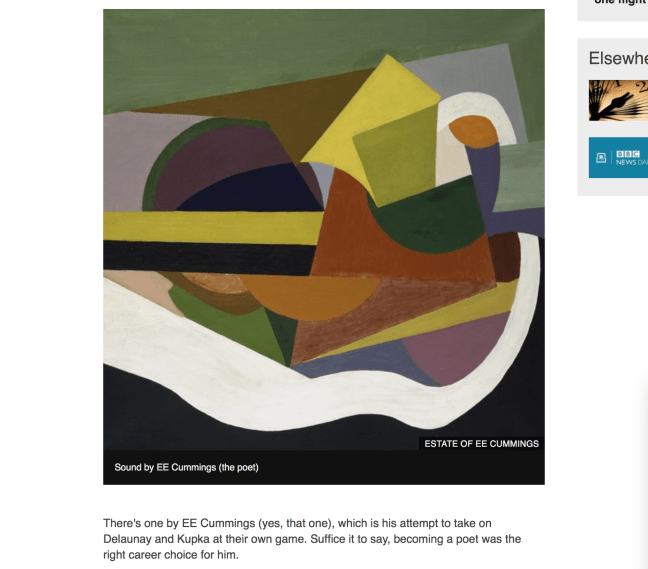
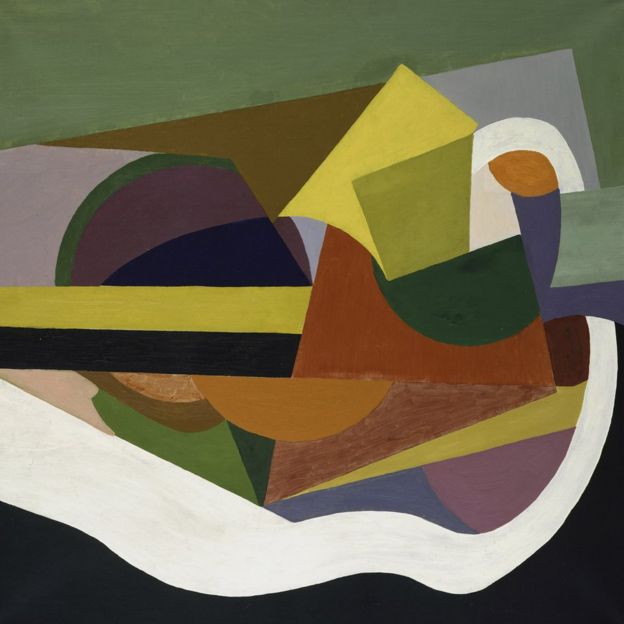
This picture and the comment below sums up my problem.. It is denigrated on an important public forum.  A value judgement has been made.  but on what grounds?

And the phrase ‘suffice it to say’ indicates that the writer thinks the judgement is shared by the reader.  (I think Kant wrote about this assumption that other people share our aesthetic judgements.)

But on what grounds is this not a good picture?

I don’t like it either but then I don’t like lots of stuff that is critically acclaimed.

Screen Shot 2018-03-25 at 02.17.56.png

http://www.bbc.co.uk/programmes/p0623pbc#play

listening to this programme which is a platform for people talking about themselves and their similarities and differences via the medium of their reactions to films. actors or whatever


relate to noe idea that we learn about ourselves by viewing art


relate to m idea that that is why the criticism industry. the never ending activity of sharing views about art


maybe this examination of ourselves via the medium of viewing art and then sharing our experience of viewing art with others – comparing and contrasting

and also this experience can exist when we confine it to our own internal consciousness i.e. we do the critical exchange of views but within our own mind only talking toourselves

maybe i am wittering on about something that everyone else also knows but i am discovering something that everybody else already knew about

http://www.bbc.co.uk/news/entertainment-arts-43502394

Review: America’s Cool Modernism at the Ashmolean ★★★★☆

Will Gompertz

A quick glance at the form-book of blockbuster exhibitions will tell you we like paintings with people in them. Rembrandt’s portraits for example, or Da Vinci’s Mona Lisa, or – currently – Picasso’s depictions of his young lover at Tate Modern. They all get us going.

True, we don’t mind the odd landscape, but usually only when it reminds us of Nature’s great power and beauty and our place in it. And yes, we’ll happily tip up to a show of abstract art as long as it’s packed with Matisse or Rothko-like emotion.

Mostly, though, we like to look at ourselves.

Which makes the Ashmolean Museum’s decision to mount a major exhibition of inter-war American paintings – on the basis that they are aggressively unpopulated and as emotionally charged as a paving slab – appear quite bold.

It’s called America’s Cool Modernism, but that’s a misnomer.

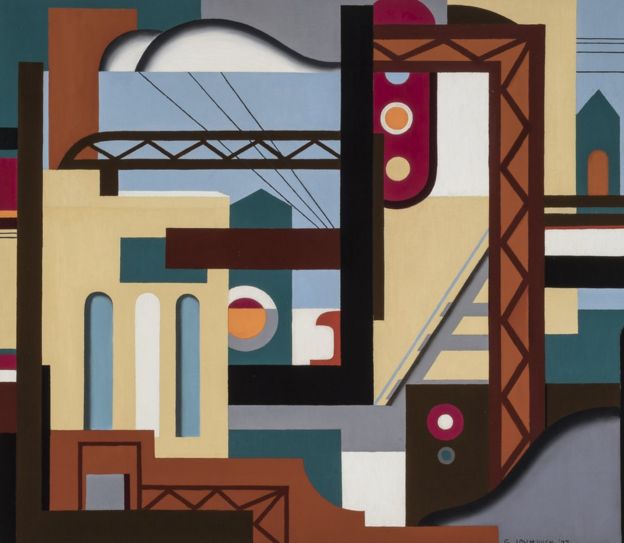
Illinois Central by George Josimovich (1927)Image copyrightTERRA FOUNDATION FOR AMERICAN ART
Image captionPeople-free zone: Illinois Central by George Josimovich
Presentational white space

The paintings you’ll see by artists, many of whom you’ve probably not heard – Ralston Crawford, Louis Lozowick, Samuel Margolies – are not cool.

They’re chillier than the Beast from the East.

We see isolated grain silos and deserted cityscapes, uninhabited interiors and bleak factories.

People? There are none. Humanity’s imprint is there but we are missing.

A surreal, macabre atmosphere hangs over this exhibition like the Great Depression. Think Giorgio de Chirico without the warmth and the wit.

Fun, it is not. Which is not to say it isn’t good. It is, on the whole.

The SunflowerImage copyrightG WILLIAMS
Image captionEdward Steichen’s The Sunflower – nice cop?
Presentational white space

The first room is thoroughly enjoyable. It plays a sort of nice cop before you meet the miserable cop in the subsequent rooms.

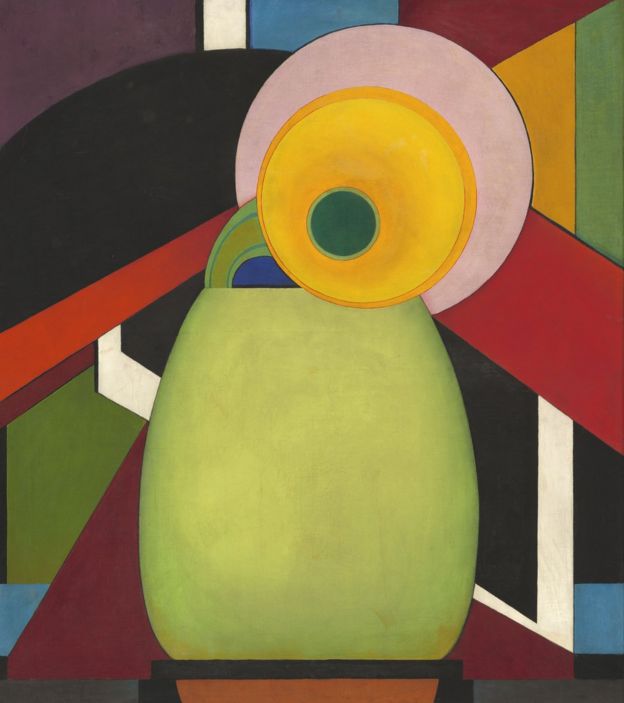
The first painting you see is of a joyful, colourful, Leger-inspired still-life by Edward Steichen called Le Tournesol (The Sunflower – 1920). Tonally, it is a world away from most of the other works in the show, but it does represent some of the main themes.

The first was the breakaway the American painters wanted to make from the largely Paris-based European avant-garde after the First World War. They were trying to create a distinct visual language to reflect America’s coming of age as a super-power, in the same way the Constructivists had done for the newly communist Russia.

It wasn’t easy. We see painting after painting owing everything to those all-pervasive early 20th Century European …isms: Cubism, Futurism, Fauvism and Orphism.

Sound by EE CummingsImage copyrightESTATE OF EE CUMMINGS
Image captionSound by EE Cummings (the poet)
Presentational white space

There’s one by EE Cummings (yes, that one), which is his attempt to take on Delaunay and Kupka at their own game. Suffice it to say, becoming a poet was the right career choice for him.

But there are others where you start to see an independent voice break out.

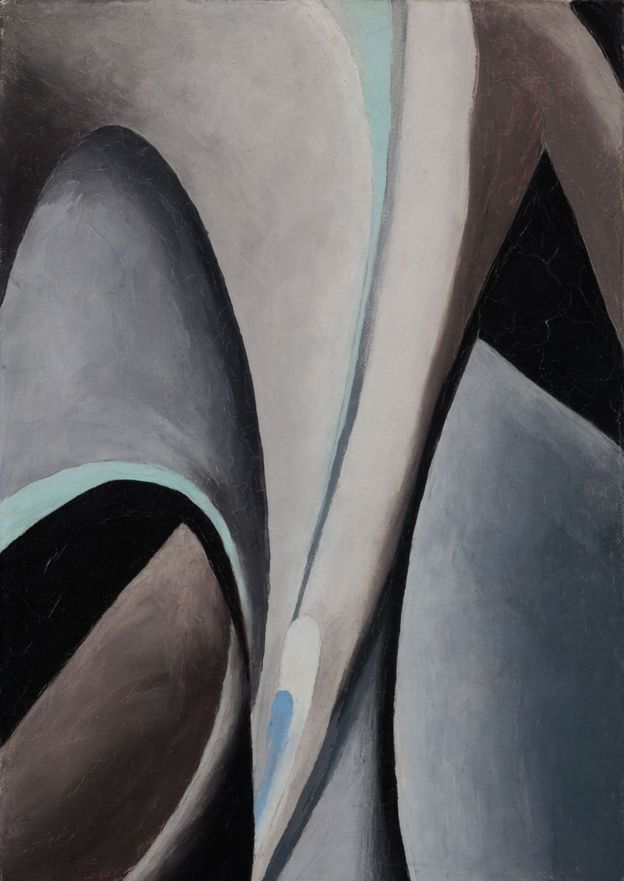
A small abstract painting from 1919 by Georgia O’Keeffe, called Black Abstraction, combines European concerns for perspective with a uniquely American sensitivity to a high-rise urban life.

Abstraction by Georgia O'KeefeImage copyrightGEORGIA O’KEEFFE MUSEUM/DACS
Image captionAbstraction by Georgia O’Keefe: An independent voice
Presentational white space

Next to it is a still-life by Helen Torr, called Purple and Green Leaves (1927). It’s not the best painting in the world but she was clearly a painter who knew how to make an impactful image. I liked its allusion to a stained-glass window.

She was one of several artists in the show whose work I didn’t know at all – I was delighted to see it for the first time. Particularly Houses on a Barge (1929), a predominately dark brown painting made in an abstracted naive style.

It is terrific: dark but wry, a Noah’s Ark of homes, which foreshadows Louise Bourgeois’s surrealist 1940-50s Manhattan images.

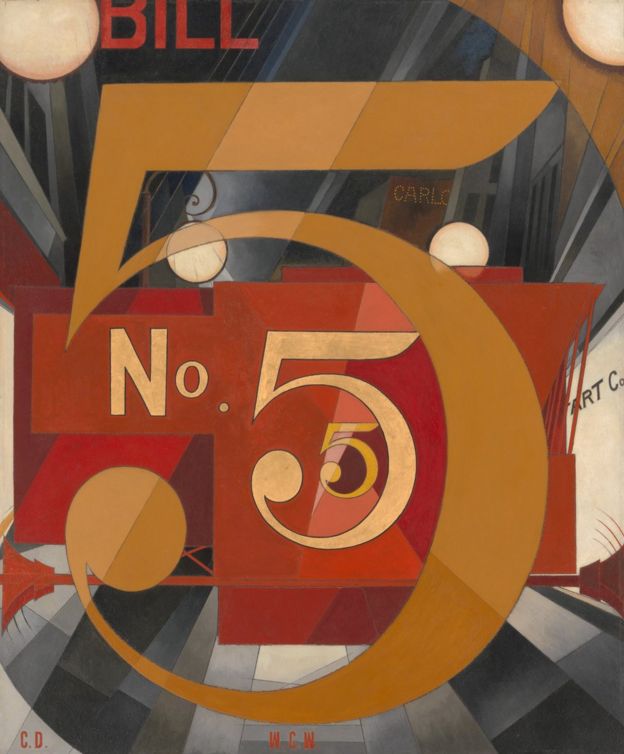
The main gallery is packed with pictures of urban emptiness, many of which have been lent by the Metropolitan Museum in New York, the most famous being the colourful, Picasso-inspired I Saw the Figure 5 in Gold (1928) by Charles Demuth.

I Saw the Figure 5 in Gold by Charles Demuth (1928)Image copyrightMET, NEW YORK
Image captionI Saw the Figure 5 in Gold by Charles Demuth appears to be inspired by Picasso

What a fine artist he was, as you will see from this well-known work that makes visible William Carlos Williams’ poem The Great Figure. There are two other paintings by him nearby, both of which are worth spending some time looking at.

The same does not apply to all the work in the show. An odd piece called Painting No 50 (1914-15) by Marsden Hartley in which he references a tepee, is one I wouldn’t have included.

But for every miss there are plenty of hits.

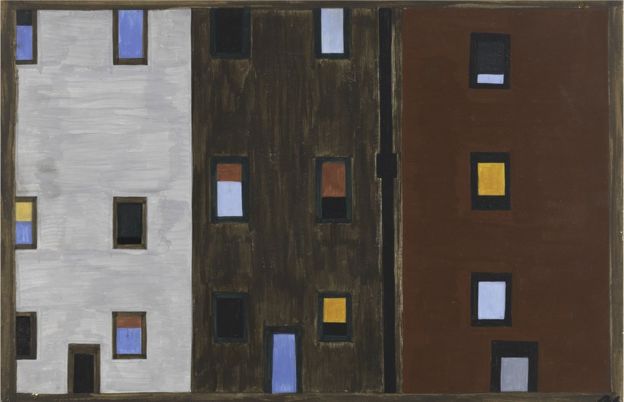
Two small, simple pictures by Jacob Lawrence from his early 1940s Migration Series gives an all-too-brief African American perspective on this extraordinary period of American History.

Their titles tell you all you need to know: The Migration Series, panel No 25 (“They left their homes. Soon some communities were left almost empty”) and The Migration Series, panel No 31 (“The migrants found improved housing when they arrived north”).

Migration 31Image copyrightWALTER LARRIMORE
Image captionMigration 31 is a simple picture by Jacob Lawrence

There are pictures in this show you will remember forever. One of which is Charles Sheeler’s vertiginous Americana (1931) in which you see a deserted sitting room with everything left just-so. It’s eerie and disorientating, with its extreme perspective and clashing rug patterns combining to make a visual assault on your senses.

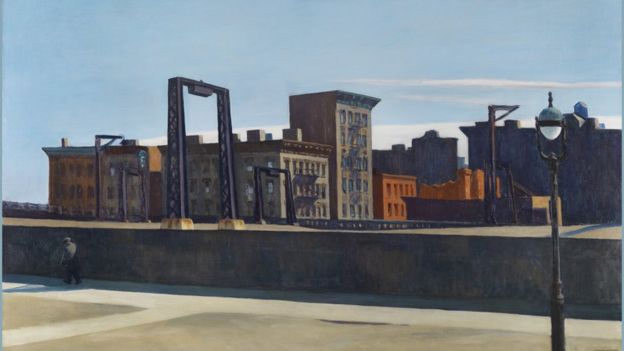
By the time you arrive at the three paintings by Edward Hopper, with which the show ends, your mind has been re-set, making these works by one of the most famous American artists of the period jar a little.

They feel overly fussy, more moody and emotional than what has gone before – added to which two of them contain human beings!

And that, if anything, gives you a sense of this impressive, intelligent show. After all, it really takes something to make an Edward Hopper painting feel overly populated.

Manhattan Bridge Loop by Edward HopperImage copyrightWHITNEY MUSEUM OF AMERICAN ART
Image captionManhattan Bridge Loop by Edward Hopper