http://www.bbc.co.uk/news/world-europe-41850348

How I threw away a work of modern art
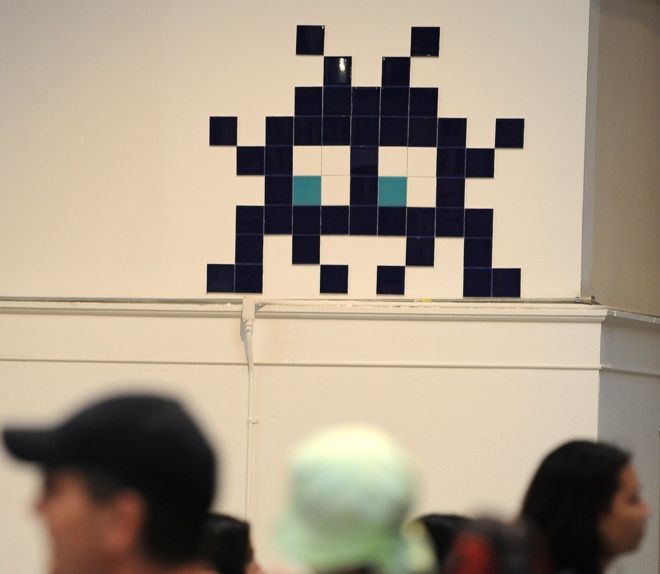
A work by French street artist Invader is on display at the 'Art In The Streets' exhibition inside the Museum of Contemporary Art (MOCA) in Los Angeles in 2011.Image copyrightGETTY IMAGES
Image captionA work by French street artist Invader on display at an exhibition in Los Angeles

To me, it looked like a child’s crude attempt at a mosaic. About a dozen small square tiles of different colours. Glued to the wall in a geometric design vaguely resembling a face with two square eyes.

It stood out in the otherwise empty and dingy Paris flat. Once my home, I was moving back in, after nearly 20 years away. My tenants, three young single men, were showing me round before they left.

“What’s that?” I asked, pointing at the cluster of tiles.

“That’s by Invader,” my tenant replied. “He’s a street artist. He’s like a French Banksy.”

I quite liked Banksy, but the young man must have seen that I didn’t appear overly impressed by his French counterpart.

“You must leave this,” he said earnestly. “One day it will be worth a lot of money.”
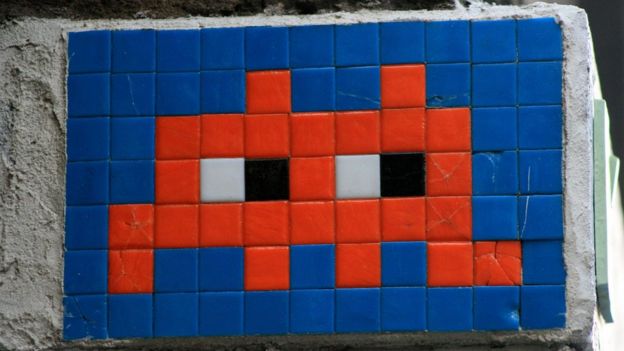
Invader art in London 2009Image copyrightALAMY
Image captionThe tiled pieces such as this one in London are inspired by the 1978 video game Space Invaders

Being British, I nodded politely – but inwardly I chortled at the notion that a few tiles stuck on a bedroom wall could ever be considered a work of art.

Trying to prove I wasn’t too old to get it, I said: “It reminds me of something.” After struggling for a few seconds to recall exactly what, I exclaimed triumphantly: “Tetris!”

Now it was his turn to look dubious, so I explained: “You know, the video game from the 80s.” “Not Tetris,” he said, mock-patiently. “Space Invaders. The mother of modern video games.”

He added: “The artist came to one of our parties and ended up staying a few months. It was his way of saying thank you. Now we’re leaving it for you.”

Read more about Invader

My neighbours had complained over the years – with varying degrees of indignation and perhaps envy – that the three young men had thrown raucous parties nearly every weekend. The flat was such a wreck that my tenant admitted that, when he was working during the week as an up-and-coming executive, he stayed at his girlfriend’s.

Now he was getting married, while I was about to transform the bachelor party pad back into a respectable bourgeois home.

The wall was stripped, replastered and painted a tasteful shade of blanc cassé

I duly promised the young men that I would look after the artwork and thanked them for leaving it. But then the builders came to replaster and repaint the room.

“I might leave that,” I told them.

They looked at me sceptically. “Why do you want to keep it? It will look strange,” the painter said.

I hesitated, but only for a moment. The wall was stripped, replastered and painted a tasteful shade of blanc cassé – off-white, far more aesthetically pleasing than a bunch of multicoloured tiles.

That was nine years ago, when I was moving back to France.


Find out more

  • From Our Own Correspondent has insight and analysis from BBC journalists, correspondents and writers from around the world
  • Listen on iPlayer, get the podcast or listen on the BBC World Service, or on Radio 4 on Thursdays at 11:00 and Saturdays at 11:30 BST

As the years passed, I noticed more of the Space Invaders mosaics on buildings around Paris. Never did I feel a twinge of regret for destroying the one in my flat.

Then, two years ago, it began to dawn on me what I’d done.

I reported on how one of the distinctive mosaics of the French street artist known as Invader was about to be displayed – on board the International Space Station. The European Space Agency said it would – in their words – highlight the bridges between art and space.

It was bigger, but otherwise similar to the one I’d unceremoniously stripped out of my flat.
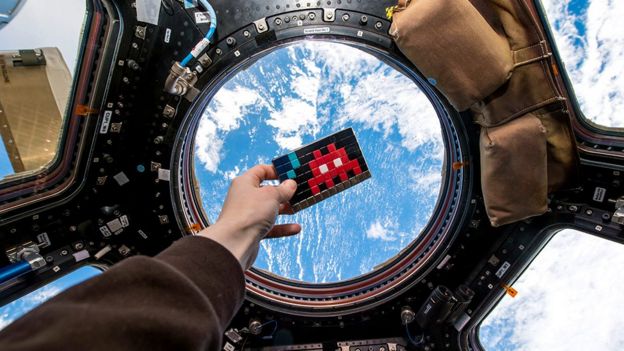
Invader art on the International Space Station, image released 11 March 2015Image copyrightESA/NASA
Image captionArtwork by Invader has turned up on the International Space Station and European Space Agency ground installations

Invader was a global phenomenon, famous in New York, Hong Kong, London, and of course Paris.

Then came the real blow. To my horror, I learned that one of his works had sold for more than €200,000 (£178,000; $233,000).

The mosaics I’d once scoffed at are now so sought-after that thieves posing as municipal workers in high-visibility vests went around Paris this summer carefully removing them.

Theft and vandalism have always been problems for Invader, a graduate of the Paris School of Fine Arts who was born in 1969, the year man landed on the Moon.

But there’s a fightback: fans known as “reactivators” photograph his works and reconstruct those that get damaged or disappear.

Had I taken a picture of the one in my flat, I could have called in the reactivators.

Now, I’ll just have to live with the fact that I tossed out a valuable work of art because I preferred a smooth, blank, white wall.

Perhaps I could try to market a piece of that as a work of art. But hold on a minute – hasn’t someone already come up with that concept?
https://www.youtube.com/watch?v=L8a7cUDJEtU

George Carlin is talking about his life ND WORK.

HE SAYS ONE reason why he does it is to show that he is still thinking:

‘People sometimes say to you, ‘Well are you trying to make people think?’ I say, ‘No, that would be the kiss of death.  What I want to do is to let them know I’m thinking.  when you drop out at ninth grade you have life-long need to prove you’re smart and the fact that Ihave made such an impression in so many places in this culture and I have said before that is my diploma but I still have a need to show that I am thinking – you know what this job is called – it’s called ‘aint I cute and aint I clever?’

2017 fuam art prize

And the winner is…

Congratulations to Zoe Carlon, winner of the FUAM Graduate Art Prize 2017!

On 27 September we welcomed back judges Nathalie Levi, David Salinger and Jane Winfrey to announce the winner of the 5th FUAM Graduate Art Prize. The prize supported by the Friends of University Art & Music (FUAM), rewards the artistic excellence of the top students completing studies in Design and Fine Art at the University of Leeds.

It’s been extremely difficult to choose an overall winner from this year’s shortlisted artists due to the quality and popularity of all their works. Indeed, the People’s Choice Award was actually awarded to another of the artists, Olivia Loker. Olivia creates digital collages inspired by popular culture. Interesting that the public chose differently to the ‘experts’!

Zoe Carlon’s paintings and charcoal drawings made her the overall winner of the £250 prize. Zoe’s work explores vacant, transitory spaces and is developed from her interest in the idea of the ‘non-place’. Zoe gave an insightful presentation about her work to a packed audience before encouraging visitors to enjoy a second, more informed look at her paintings and sketches.

Thank you to everyone who voted for the People’s Choice Award. If you fancy admiring Zoe’s, Olivia’s, Miranda’s and Lucy’s work one more time, the exhibition doesn’t close until Saturday 4 November so there’s still plenty of chance to see if you agree with the judges or have a different opinion!

3 october


The Green Room with paul provenza

pp kicks it off at c 17.53 that alks anout news being fear mongering to distract us from the fact that we are slaves to a handful of multinational corporations (eg that woman talking about JC did not have any arguments to back up her epressed emotional revulsion for jc. All she had was the emotion not the reason why

then tim Minchin relates it to comedy

“I don’t do comedy about politics in the domestic politics sense. The reason I do comedy about logic, religion and belief systems is because I feel I can go ‘Well that’s fucking wrong – this is why that’s fucking wrong and that’s why I avoid politics because I cannot get what’s right and wrong about it.

PP agrees and says its because TM values critical thinking and critical thinking is missing on both sides of republican democrat.

Jimmy carr says he does not use politics in his comedy – he just wants to make people laugh.

PP says that makes him part of the distraction that the media which is ‘a handful of corporations have decided the narrative that you now engage in.

TM says when t comes to politics and comedy he is frustrated by the limitations of the power of critical thinking. All his beliefs are formed like this ‘I’m gonna try and be as clear thinking as possible and then you hit politics and because of the massive complication of the media and the narrative that we are sold and your powers are useless because you don’t have all the information. If you do comedy about what on the fron of the newspapers, someones telling you what to think about that’s because the papers are telling you what’s important today


Then Eddie Izzard commits to standing for Mayor of London or an MP. Jimmy Carr says why wouldhe want to go into politics when he is already so successful in comedy and films

EI says it is because he wants to stand up against the fascists


http://www.alvanoe.com/videos/

‘Artists make things not because the things they make are special but because making is pencil for us.


We are makers…manufacturers.  What seems to inaugurate the beginning odour the psychologically modern human being is this explosion of making practices of tools making and using pictorial practices linguistic practices.


Artists make things to unveil that fact about ourselves

Works of art are strange tools that in their strangeness are meant to exhibit the place that tools and technology have in our lives (Pat thanks this i like gel’s ideas)

philosophers and scientist think of art as a phenomenon that can be examined.  Noe things that art is itself its own research practice it is a way of trying to understand the world and ourselves (Pat: nowt new here).

the best way to answer the questions e.g. why does art matter is to think of art was out collaborator in answering these questions rather than the object of the questions.

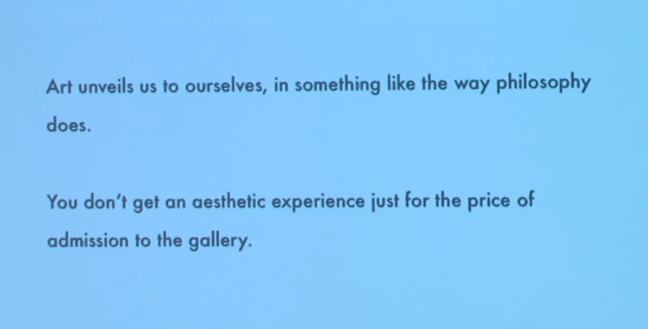
The art situation is the way to put ones own perceptual understanding into view for oneself.  art is a philosophical practice.

both art and philosophy unveil ourselves to ourselves and by doing so provide us with resources to change.


Pat: nowt new here

https://evolution-institute.org/article/the-riddle-and-the-range-of-art/

BBSteven Pinker proposes, as he has since How the Mind Works (1997), that art is not an adaptation, but a byproduct: a byproduct, specifically, of our sensory and cognitive pleasures and our technical capacity to create works that will appeal to those pleasures. He once called art “cheesecake for the mind,” an intense dose of sensory pleasure made according to human recipes. Now he puts it less provokingly, but no less firmly: we make art simply because we can, because we know our pleasures and can find ways to satisfy them.

Geoffrey Miller proposes, as he has since his dissertation (1993) and The Mating Mind (2000), that art is not an adaptation but a product of sexual selection. In its original version, he argued for male display and female choice, but he soon revised this to mutual mate choice. Artistic signals display genetic quality. Miller invokes Amos Zahavi’s handicap principle: art consists of “costly, hard-to-fake signals of the artist’s skill.”

Mark Changizi has never really advanced a hypothesis about art as a whole, as he freely admits. Instead, he has aimed, especially in Harnessed: How Language and Music Mimicked Nature and Transformed Ape to Man (2011), to show how human artifacts harness unexpected aspects of human nature. Music’s features reflect in precise and unexpected ways the sounds made by human movement, and writing reflects the attunement of our visual system to edge detection, especially at the conjunctions of objects. Visual art similarly focuses on features of human skin color and texture and anatomical articulation.

I see art as cognitive play with pattern. Play has been found in all mammals where it has been looked for, in birds, reptiles, and invertebrates. It trains animals in core behaviors in their particular niche—behaviours like chase, fight, flight—which they practice exuberantly in non-urgent situations so they can perform better in urgent ones. This kind of practice has been so advantageous that it has evolved to become compulsive, fun, irresistible.

We humans are not particularly swift or strong for our size; we don’t have real physical advantages, except perhaps in our manual dexterity and vocal articulation. But we do have mental advantages, both individually and perhaps especially collectively, through all we learn from others. And minds work through pattern recognition. Human minds have a singular appetite for patterns, and we play with it both individually and by engaging with the patterns others around us have developed, in images, sounds, stories and more. We find this play compulsive from infant pretend play and nursery rhymes to sing-alongs and dances in old folks’ homes.